
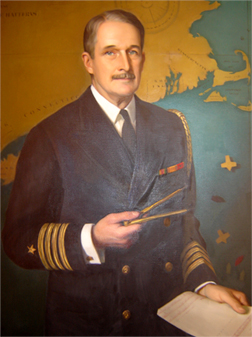
Captain Eppley was a physical chemist, born in New Jersey in 1883. Studying at Princeton, he received his M.A. in 1912 and his Ph.D. in 1919.
The First World War cut off the US supply of standard cells from Germany that were needed for precise calibration of potentiometers and other electrical manufacturing instruments. At Princeton, Captain Eppley had begun experimentation in the manufacture of these cells and in 1917 launched the Eppley Laboratory in Newport, Rhode Island, to produce them.
In the course of his career, Captain Eppley worked to improve the efficiency and reliability of cadmium standard cells through research in theoretical aspects of electromotive force in Ostwald’s dilution law, relating ionization of an electrolyte to its concentration, and in general theory of solutions. Under Captain Eppley’s guidance, the Eppley Laboratory also entered the field of thermal radiation and today continues to be involved in both laboratory and solar measurement of radiation. Captain Eppley directed the Eppley Laboratory until the end of his life.
In 1947, Captain Eppley established The Eppley Foundation for Research. On his death in 1960, his will created the Eppley Charitable Trust, the income from which also goes to support the work of the Eppley Foundation.
Twice in the course of his career Marion Eppley’s work was interrupted by service to his country. During the First World War he served as a lieutenant commander and he was recalled to duty in 1941 as a captain. He was with the Pacific Fleet until the conclusion of hostilities as personal representative of Chester W. Nimitz, Fleet Admiral, and he was awarded the Legion of Merit.
Today, through Captain Eppley’s generosity and foresight, the Foundation is able to continue to contribute support and encouragement to new generations of scientists in their search for insight into the workings of the world, as was the Captain’s wish.
Board of Directors
Rivington Winant, President 1960-2011
Joan O’Meara Winant, President
Constance Hermance
John Winant, M.D.
Janine Winant
Cynthia Zujkowski
The Eppley Foundation for Research was incorporated in 1947 for the purpose of “increasing knowledge in pure or applied science…in chemistry, physics and biology through study, research and publication.”
The Foundation does not support work in the social sciences, education or computer science, and only rarely funds research into diseases that have considerable financial support available, such as AIDS, diabetes, cancer and heart disease. Particular areas of interest include innovative medical investigations, climate change and the oceans.
The Foundation does not fund work that can qualify for funding from conventional sources such as the National Science Foundation or the National Institutes of Health, or similar agencies at the state level.
It is important to the Foundation that the work proposed be novel in its insights and unlikely to be underway elsewhere. The Foundation is prepared to take risks.
Who may apply
The Eppley Foundation supports advanced, novel, scientific research by PhDs or MDs with an established record of publication in their specialties. Candidates with newly awarded doctorates occasionally, but rarely, meet the Foundation’s requirements for advanced research. Any applicant to the Foundation must be associated with a nonprofit organization with headquarters or a branch office in the US to process the funds. Checks are not issued directly to individuals.
Grants may be awarded for research in foreign countries but only when such applicants are US-based or associated with a US institution that will administer the grant on their behalf. The Foundation rarely considers proposals from foreign nationals studying in the US solely because they are therefore unable to qualify for federal funds.
LOIs and Proposals
The Foundation is currently accepting letters of inquiry.
Letters of inquiry and grant proposals should be written in language clear to the layman. LOIs, not to exceed 1,000 words, should be received by September 7, 2026. LOIs should specify the sum that will be requested. For invited proposals, due on October 23, there is no page limit, but the proposal — as the LOI — is expected to be concise and incorporate clear statements of significance, objectives, novelty, methods, expectations of success, and why the researcher believes the work cannot reasonably expect federal support, or support from other conventional funding sources. There should also be a discussion of the broader ramifications of your work once it is completed.
Notification of a successful application usually follows within two weeks of board meetings. A true emergency may be considered outside this schedule.
Required documents
- LOIs require no attachments.
- Invited candidates should fill out an application form to accompany their grant proposals.
- Two letters of reference are required from scientists acquainted with the investigation and with the researcher in search of support. The letters should accompany the grant proposals.
- A cv should be included for each investigator.
- Include a budget, as described below.
The Eppley Foundation for Research is a small, family foundation that disburses up to $460,000 a year. Dozens of proposals compete annually for this modest sum.
The Foundation rarely provides operating funds: The Foundation will fund a specific investigation in its entirety or a specified portion of a larger project. In the case of the latter, the Foundation requires assurance that all funds will be in hand at the time the research begins to ensure that the work proposed can be completed. When the Foundation is asked to fund the first year of a multiple-year investigation, all funds must be committed at the time of initiation in order to ensure that the work can be sustained until its completion.
An itemized budget should accompany all proposals, and a budget justification. The Foundation limits its contribution to overhead to 15 percent. Travel and fringe benefits do not qualify for overhead allocation.
The grant proposal may include requests for equipment, but the Foundation does not fund proposals that are primarily for equipment.
Grant recipients should promptly acknowledge receipt of funds.
An interim report, which may be a letter, is required after half a year. A full report is required from grant recipients after one year. This report should follow precisely the sequence of events in the proposal, addressing each step or goal as discussed in the proposal.
Should the need arise for a substantial change in research protocols, timetable or budget allocations, the Foundation should be notified in advance.
Please email to eppleyfoundation@gmail.com a copy of any publication arising from work supported by The Eppley Foundation for Research.
Contact
If invited to send a full proposal, send two complete printed copies to the address below and an e-mail copy to eppleyfoundation@gmail.com.
Attach your proposal to your email as a pdf file. Put your last name and a key word from your proposal title in the subject line of your email, and be sure to include the full title of your proposal in the body of the email.
Ms. Joan O’Meara Winant, President
The Eppley Foundation for Research, Inc.
215 East 72 Street 10E
New York, NY 10021
